New account, experienced owner
A newly deployed account contract can belong to an established trader. An old address may only recently start trading on Polymarket. Scanner first-seen time adds no score.
Reading guide
The tool groups stored Polymarket trades by market and highlights patterns for human review. It does not identify insiders, prove coordination, or estimate the probability of misconduct.
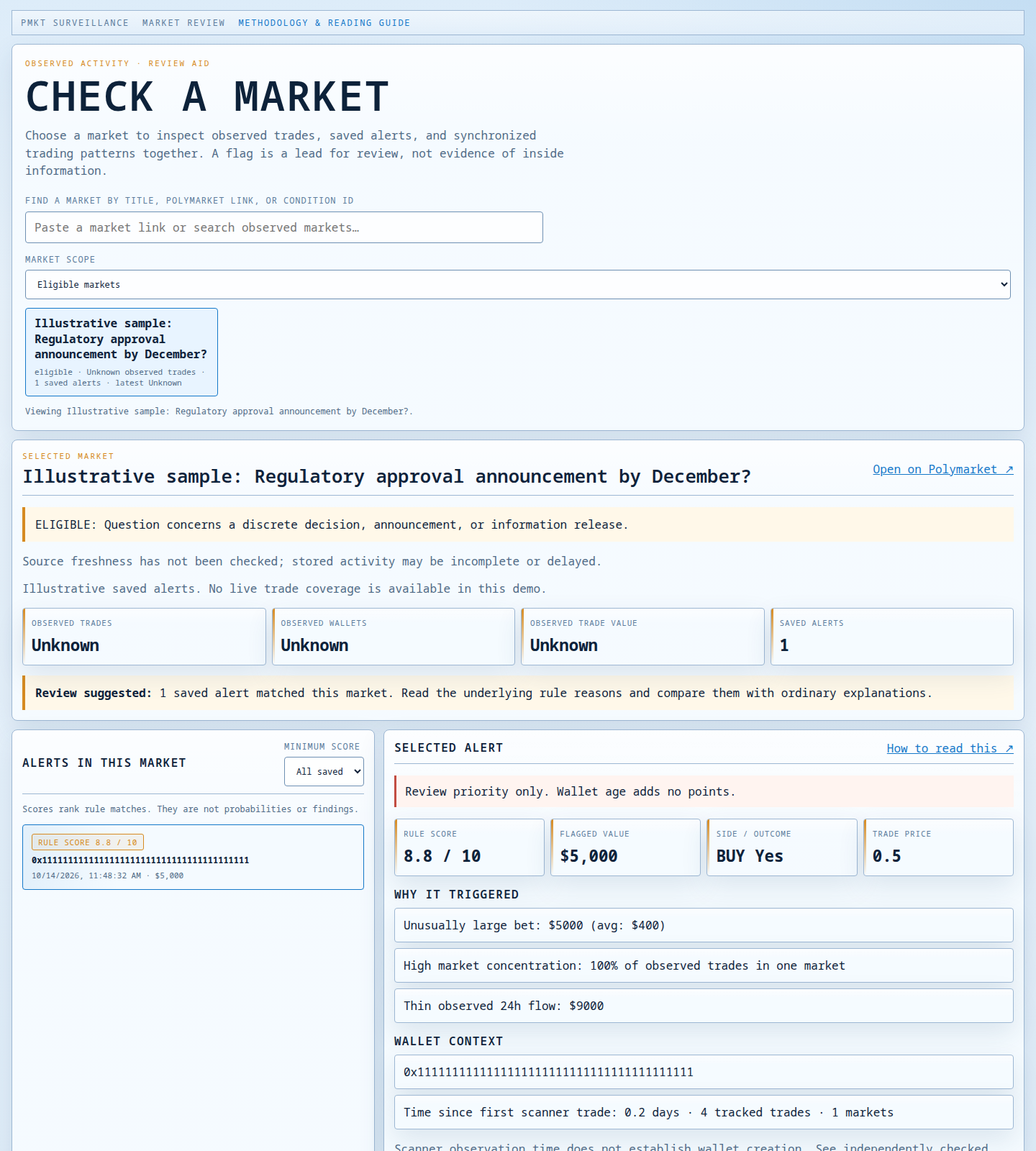
Choose a market →This screenshot uses a saved sample alert. The numbers identify what to examine in the interface; it is an illustration, not a live market finding.
 1234
Sports and election-result markets are excluded. Ambiguous political decisions and questions without an explicit eligible rule require operator review. Eligible questions concern a discrete decision, announcement, or information release. Scope uses event tags and question rules; a recorded operator override can change it. An excluded or unreviewed market produces no insider review alerts. The scanner checks a bounded selection of eligible markets for both individual trade alerts and synchronized trading patterns. Sports, election-result, and unreviewed markets are outside that selection unless their scope changes. The recent review leads list shows a small set of saved results, not complete market coverage.
Rules add up to three raw points for unusual value, two for concentration, two for thin observed flow, and one for repeated entries. The eight possible raw points are scaled to 0–10. Wallet age contributes no points. The threshold is configurable; the score ranks rule matches and does not estimate the probability of misconduct. Each short insider explanation paraphrases saved rule reasons and states this limit. Older saved scores are adjusted once to remove the former scanner-age rule and use the new scale.
At least three distinct wallets must take the same outcome and direction within a rolling two-minute window, with at least $1,000 combined value by default. Duplicate observations are removed and fills from one wallet in the same transaction are grouped. With at least ten other observed actions spanning at least thirty minutes, a burst must have at least three times the baseline action rate. Otherwise it is explicitly labeled as having an insufficient observed baseline, and timing rarity is not estimated.
Repeated wallet pairs are compared with retained patterns from the prior thirty days, using episodes separated by at least thirty minutes. Direct token transfers and common senders are shown only from cached explorer records dated at or before the detected burst; common senders can be exchanges or services and are weak context. Each short pattern explanation reports the stored wallet count, action count, direction, time span, and value when available. These observations never establish beneficial ownership or confirmed coordination.
First public Polymarket activity uses the earliest returned full-history record, including deposits and withdrawals. Verified contract deployment is a separate Polygon transaction. Neither establishes that the owner is a new trader. EOA private-key creation cannot be dated from public records. Failed checks and missing records stay unknown; evidence shows when it was checked.
A newly deployed account contract can belong to an established trader. An old address may only recently start trading on Polymarket. Scanner first-seen time adds no score.
Hedging, rebalancing, market making, or topic specialization can look unusual. Sparse collection can distort the comparison.
Stored trade value is not market liquidity. Missing or delayed ingestion can exaggerate this signal.
News, bots reacting to public signals, exchange withdrawals, and routine strategies can produce aligned trades or a common sender. Check alternatives before inferring a relationship.
By default, discovery looks at up to 300 open events per refresh and scans up to five selected eligible markets per pass. Selection favors higher-volume eligible markets within the configured range. These caps and polling intervals can be changed by the operator; the dashboard cannot infer unseen market activity. The worker refreshes discovery about once an hour and rotates its five-market scan batch through the cached eligible set between refreshes. A scan pass covers only its reported batch; the candidate set can change at each refresh.
Trade collection uses Polymarket Data API v2 cursor pages, locally bounded to the collector’s checkpoint. Public market feeds serve taker-side rows once per fill; this is not a complete view of every participant or private order. Identical returned trade records are deduplicated, so fills without distinguishable identities can be collapsed. The visible trade cards show only the latest thirty stored trades in the last twenty-four hours. Saved alerts use the server’s configured alert window.
The source freshness check is cached and may itself be old; compare its check time and reported lag with the trade timeline. The market view examines funding context for up to twenty stored member addresses per displayed pattern and only the latest one hundred explorer token-transfer rows per checked wallet, not a complete funding history. Thirty-day repeat evidence covers patterns observed by this installation, not all historical relationships. No record or no alert does not clear a market.
The tool does not verify private information, intent, beneficial ownership, or all cross-market positions. A substantive claim requires source records, a public-information timeline, and independent review.
Sources: Data API migration · Wallet activity · Contract deployment records